
Written by Andrea Finnegan,
Programme Manager,
World Vision Ireland
While preparing a presentation on our Education Cannot Wait work, I asked my six-year-old son a simple question: "What does education mean to you?"
He paused for a moment, surprised by the question. Education is a given for him. School is part of his daily routine and something he has never had to question. So I asked differently: "How does school make you feel?"
His answer was immediate: "Happy. It's fun being with my friends. I miss them when we're not at school."
When I think of school and why it is lifesaving, I can list a number of reasons, but perhaps one of the most important reasons, like that of my 6-year-old, is that school, in addition to learning, can offer safety, belonging and connection. For children living through conflict, displacement, climate shocks and other crises, those benefits can be lifesaving. During COVID-19, when schools were closed, many vulnerable children missed out on school and the daily safety, nurturing and protection teachers and schools can offer. Education In Emergencies (EIE) provides a level of normality, play, learning and often access to some level of mental health and Psychosocial support.

Today, there are 234 million crisis-affected school-aged children and youth, and approximately 85 million (37%) are out of school. Education globally is under threat, even more so in emergency contexts; Official Development Assistance is declining in a world where humanitarian needs are rising.
UNESCO estimates that continued failure to ensure that all children gain basic skills results in a global loss of $10 trillion annually. If we fail to educate children who are increasingly caught in crisis, on the move and denied a chance to learn, we are missing the opportunity to build stability and safer nations.
Often, education is not prioritised in an emergency response, as it is not seen as lifesaving. But education is lifesaving and can be used in emergencies to reach children, provide necessary support, educate future generations and provide hope. Did you know that a child born to a mother who can read is 50% more likely to survive past the age of 5? Proof that EIE can change the direction of a child’s life.
Education does more than prepare children for the future; it helps protect them today.
Education in Emergencies is essential if we are to provide for current and future generations. My colleague in South Sudan, James Ring Ring (Zonal Coordinator for Upper Nile), is a powerful example of this impact. James continued his education while living in a refugee camp in Kenya before eventually returning home to South Sudan to rebuild his community. His story demonstrates how access to education can provide hope and opportunity, even in the most difficult circumstances.

The lines between emergency and protracted crises are increasingly blurred. Conflict, climate change and natural disasters are causing children to miss prolonged periods of school. After repeated closures or displacement, we see that some children never return to complete their education- instead forced into negative coping mechanisms such as child labour, child marriage or military recruitment. If education was prioritised, it could reduce the number of climate-related deaths due to natural extreme events in sub-Saharan Africa by 60%. Moreover, if children do not reach a basic level of skills, literacy and numeracy, the incidence of sexual violence is 27% higher.
Education is lifesaving.
My field trips to World Vision’s education projects in some of the most difficult contexts in Somalia, South Sudan, Sudan and DRC have convinced me of this even more.
In these protracted crises, low-resource settings, we have enabled school environments that are safe and inclusive, increasing student enrolment and the valued importance of education within the community. We use a whole-of-school approach, looking at the ecology within and around the schools, valuing the importance of volunteers, caretakers, and faith leaders, and their role in educating the future of their community.
Guided by local governments and ministries, we work with decision-makers to deliver school curricula to the children in hard-to-reach, underserved locations. Core to our EIE work is protection and quality learning for school-aged children, youth and even women and men who can access reading clubs or Income-Generating Activities.
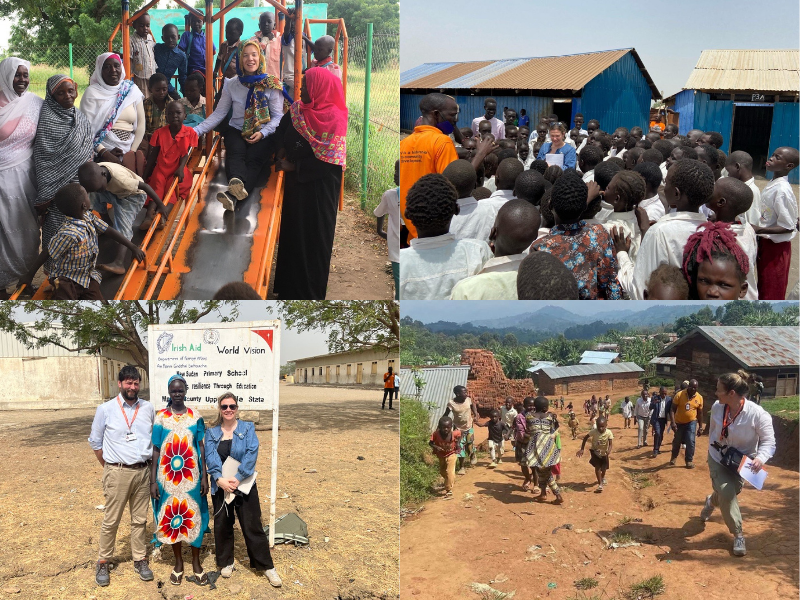
Photos of Andrea's field trips to various education projects
World Vision is working to build safe, healthy and educated communities.
My son's answer was simple: school makes him happy because it is where he learns and spends time with his friends. For millions of children affected by crisis, school is much more than that. It is a place of safety, protection, hope and opportunity.
At a time when humanitarian needs are rising and funding is under pressure, we cannot afford to treat education as optional. Education in emergencies is not a luxury. It is lifesaving, transformative and an investment in the stability, resilience and peace of future generations.
